Can a Raise That Bumps Your Tax Bracket Cost You Money?
No: a higher rate only applies to the slice of income above the line. How tax brackets really work, marginal versus average rates, and the real traps to watch.
Someone gets offered a raise and hesitates. It would take them into a higher tax bracket, and they’ve heard that would mean paying the higher rate on everything, so they’d end up taking home less. Some people have turned down raises because of this. Others have avoided overtime, or a better job.
So: can a raise that bumps you into a higher tax bracket leave you with less money?
No. In the US, the UK and most other countries with income tax bands, a raise always leaves you with more money from the bands themselves. The higher rate only applies to the part of your income above the line. The myth is one of the most widespread money misunderstandings there is, and it costs people real money, so it’s worth seeing exactly how the system works.
Try it
Can a raise make you take home less?
Set your pay, then give yourself a raise that crosses into the 40% band.
Before: you keep $41,600. After the $3,000 raise: $43,600, which is $2,000 more. Only the slice above $50,000 is taxed at 40%. If the whole salary were taxed at the top rate, as the myth says, you'd keep $31,200.
How tax bands work
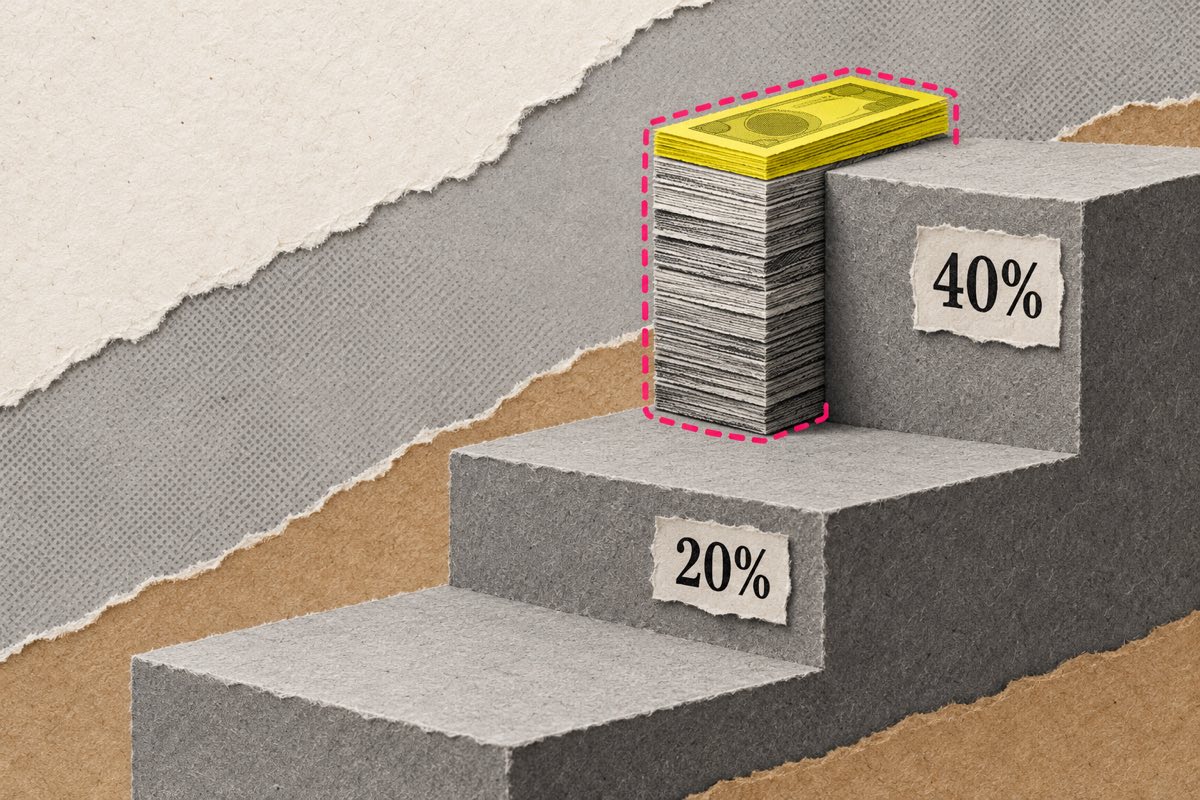
Income tax is usually charged in bands (also called brackets). Here’s a made-up example, not any real country’s:
- the first $12,000 of income: 0%
- from $12,000 to $50,000: 20%
- everything above $50,000: 40%
Each rate applies only to the slice of income inside its band. Picture your income as water filling a series of buckets. The first bucket holds $12,000 and isn’t taxed. Once it’s full, money spills into the second bucket, taxed at 20%, until that holds $38,000 more. Only what spills over after that lands in the 40% bucket. Pouring more water in never changes what’s already in the lower buckets.
Someone earning $49,000 pays nothing on the first $12,000 and 20% on the next $37,000: $7,400 in tax, so they keep $41,600.
What happens with a raise
Now they get a $3,000 raise, to $52,000. The first $50,000 is taxed exactly as before. Only the $2,000 above $50,000 is taxed at 40%.
- Tax on the first $50,000: $7,600
- Tax on the $2,000 above it: $800
- Total tax: $8,400, and they keep $43,600
That’s $2,000 more in their pocket than before the raise. The 40% rate took a bigger share of the last $2,000, but it didn’t touch the rest. Try it in the toy at the top: give yourself a raise across the line and watch the take-home pay rise.
The myth, and why it’s wrong
The myth imagines that crossing into a higher bracket makes the higher rate apply to all your income. If that were true, $52,000 taxed entirely at 40% would leave just $31,200, a loss of more than $10,000 from a $3,000 raise. No modern income tax works like that, precisely because it would make raises punish people.
Try it
Should you turn it down?
Your taxable income is $45,000. A raise would take it to $50,000, over the line into the US federal 22% bracket (from 12%). A colleague says: “Turn it down, you’ll pay the higher rate on everything.” What actually happens?
Pick one. You’ll see why straight after.
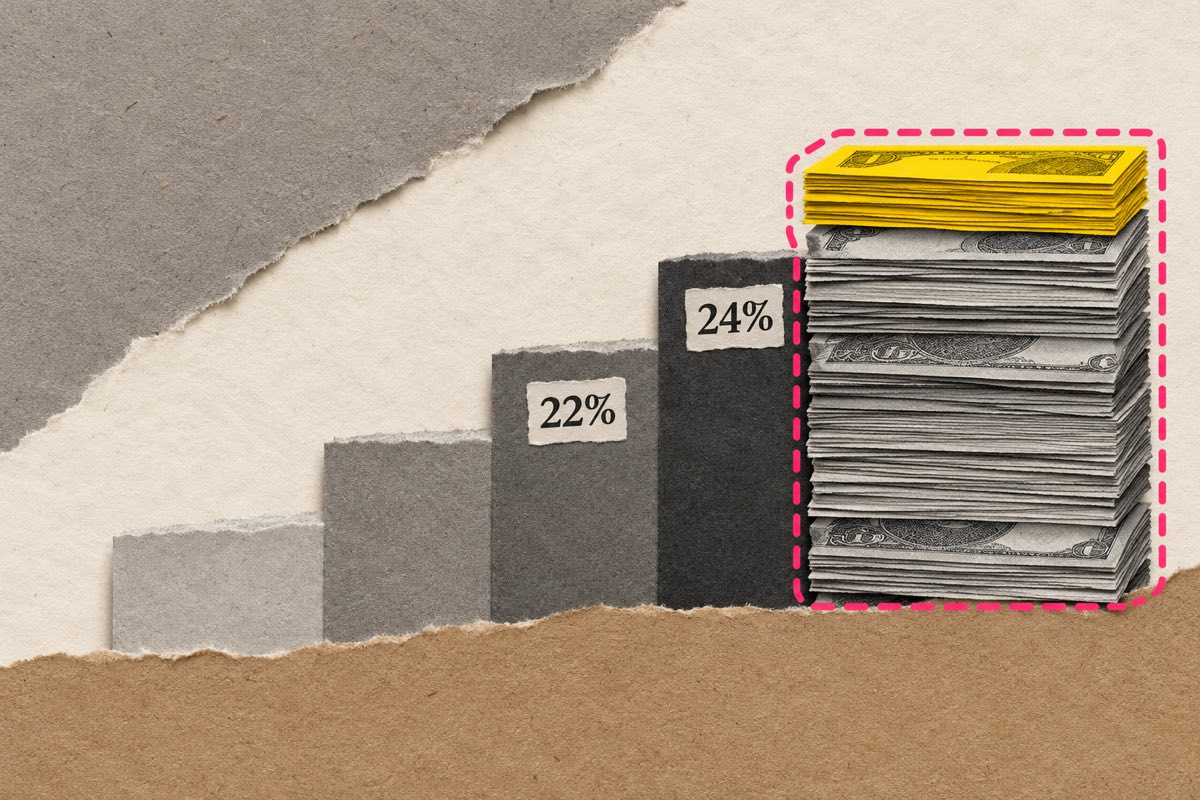
The real US federal system has seven brackets, from 10% to 37%. The UK has a tax-free personal allowance and then rates of 20%, 40% and 45%. Different numbers, same principle: each rate applies only to income inside its band.
Where the myth comes from
Part of it is language. “I’m in the 40% bracket” sounds like “40% of my money goes in tax”, when it really means “my last pound is taxed at 40%”. Part of it is that some things really do behave like a cliff, such as the benefits described below, and people who’ve been caught by one remember it. And part of it is that payslips rarely show how tax is worked out, so the only thing people see is a bigger deduction after a raise, without the breakdown that shows most of the raise survived.
There’s also a confusing transition month. If a raise starts partway through a tax year, or a bonus lands in one pay packet, the tax taken that month can look alarmingly high, because payroll systems work it out as if you earned that much all year. It usually evens out by the end of the year.
Marginal and average rates
Two numbers describe your tax, and mixing them up fuels the myth.
The rate on your next dollar is your marginal rate. That’s the rate people mean when they say “I’m in the 40% bracket”.
The share of your whole income that goes in tax is your average or effective rate. In the example, after the raise, the marginal rate is 40%, but the average rate is only about 16%: $8,400 of tax on $52,000.
| Income | Tax | Take-home | Marginal rate | Average rate |
|---|---|---|---|---|
| $30,000 | $3,600 | $26,400 | 20% | 12% |
| $49,000 | $7,400 | $41,600 | 20% | 15% |
| $52,000 | $8,400 | $43,600 | 40% | 16% |
| $80,000 | $19,600 | $60,400 | 40% | 25% |
Your average rate always sits below your marginal rate, because the lower slices are taxed less. And it rises smoothly with income, with no sudden jump at a bracket line. The jump is only in the rate on the next dollar.
Both numbers are useful. The marginal rate tells you how much of a raise, a bonus or extra hours you’ll keep. The average rate tells you how much of your income goes in tax overall.
The real traps
The bands themselves never make a raise cost you money. But some things that depend on your income can create sharp edges, and they’re worth knowing about, because they’re probably where the myth started.
Benefits or credits that stop at an income limit. If a benefit, a childcare subsidy or a tax credit stops entirely once you earn over a certain amount, earning just over the cut-off can mean losing support worth more than the raise. These are called benefit cliffs, and they’re a genuine problem in some welfare systems. Most systems now phase support out gradually instead, but cliffs still exist.
Allowances that taper away. In the UK, the personal allowance is reduced by £1 for every £2 of income above £100,000, until it’s gone at £125,140. In that range, each extra pound costs 40p in tax plus 20p in lost allowance, an effective marginal rate of 60%. It’s the steepest band in the system, and many people don’t know it exists.
Try it
The UK’s hidden 60% band
In the UK, the tax-free personal allowance of £12,570 shrinks by £1 for every £2 earned over £100,000. That creates a real trap, which isn’t the bracket myth. Slide the salary (income tax only, 2024–25 rates, ignoring National Insurance and the 45% band).
At £105,000, you’d keep only about £400 of your next £1,000 in income tax terms: a 60% marginal rate, because each extra pound also takes away 50p of tax-free allowance. It’s still more money, not less, but it’s the steepest band in the system.
Even then, you’re losing allowances or benefits, not having a higher rate applied to all your pay. And outside a sharp cliff, you still keep some of every extra pound.
Other deductions. In the UK, National Insurance and student loan repayments are taken from pay too, so the share of a raise you keep can be lower than the income tax rate alone suggests. In the US, state income taxes and payroll taxes add to the federal rate. None of these reaches back to re-tax income below a line, but they matter for working out what a raise is really worth.
The quiet one: bracket creep
There’s a subtler effect that does catch people. When tax thresholds stay fixed while wages rise with inflation, people are gradually pulled into higher bands even though they’re no better off in real terms. Economists call this bracket creep or fiscal drag.
The UK froze its main income tax thresholds in 2021 and has kept them frozen until 2028. The Institute for Fiscal Studies has estimated that this pulls millions of extra people into paying tax, or into paying the higher rate, by the end of the freeze. No rate goes up, but more of people’s income ends up in the higher buckets. That isn’t the myth either, but it’s a real way the bands can take a bigger share over time.
What to do with this
- Take the raise. From the bands themselves, more pay always means more take-home pay.
- Know your marginal rate. It tells you how much of a raise or bonus you’ll keep.
- Check for cliffs. If you receive a means-tested benefit or credit, or you earn near a taper like the UK’s £100,000 line, look at the rules before you assume.
- Think about pensions in the steep bands. In some systems, paying into a pension reduces taxable income, which can be especially valuable in a high-marginal-rate band. That’s worth checking with an adviser.
This page is general education about how income tax bands work, not tax or financial advice. Rules and rates change, and differ between countries and regions.
The free money test asks about tax brackets alongside nineteen other everyday money questions.
Questions people ask
- Do you pay the higher rate on all your income if you move up a tax bracket?
- No. The higher rate applies only to income above the bracket’s threshold. Everything below is taxed at the lower rates exactly as before. Moving into a higher bracket changes the rate on your extra income, not on the income you already had.
- What’s the difference between marginal and effective tax rates?
- The marginal rate is what you pay on your next dollar or pound of income. The effective or average rate is your total tax divided by your total income. Because the lower bands are taxed less, your average rate is always below your marginal rate.
- Can a pay rise ever leave you worse off?
- Not because of the tax bands themselves. But if a benefit, tax credit or subsidy stops abruptly at an income limit, earning just over it can cost more than the raise is worth. These are called benefit cliffs, and they’re worth checking if your income is near a cut-off.
- What is the 60% tax trap in the UK?
- Between £100,000 and £125,140 of income, the tax-free personal allowance is withdrawn at £1 for every £2 earned. Combined with the 40% rate, each extra pound in that range effectively costs 60p in income tax. You still keep 40p of each pound, so you’re better off, but by less.
- What is bracket creep or fiscal drag?
- When tax thresholds don’t rise with inflation, pay rises that only keep up with prices pull more people into higher bands. Their real income hasn’t grown, but they pay a larger share in tax. Governments sometimes freeze thresholds deliberately, as the UK has done until 2028, to raise money without changing rates.
Sources and further reading
- Internal Revenue Service. Federal income tax rates and brackets (2024).
- HM Revenue & Customs. Income tax rates and personal allowances, 2024 to 2025.
- Institute for Fiscal Studies. Fiscal drag: An old trick back in fashion (2022).
- Tax Policy Center. How do marginal income tax rates work, and what if we increased them?
- Kosar, G. and Moffitt, R. A. (2017). Trends in cumulative marginal tax rates facing low-income families. Tax Policy and the Economy, 31, 43–70.