Does the Full Moon Make People Act Strangely?
Nurses, doctors and police swear the full moon brings chaos. Decades of studies find no such effect. Why the belief feels true, and what the Moon really does.
Ask anyone who works nights in an emergency department whether the full moon makes people act strangely, and there’s a good chance they’ll say yes, with feeling. They’ll tell you about the night the waiting room overflowed, the patient who took his clothes off in the car park, the three fights before midnight. Police officers say it. Midwives say it. Teachers say the children go wild.
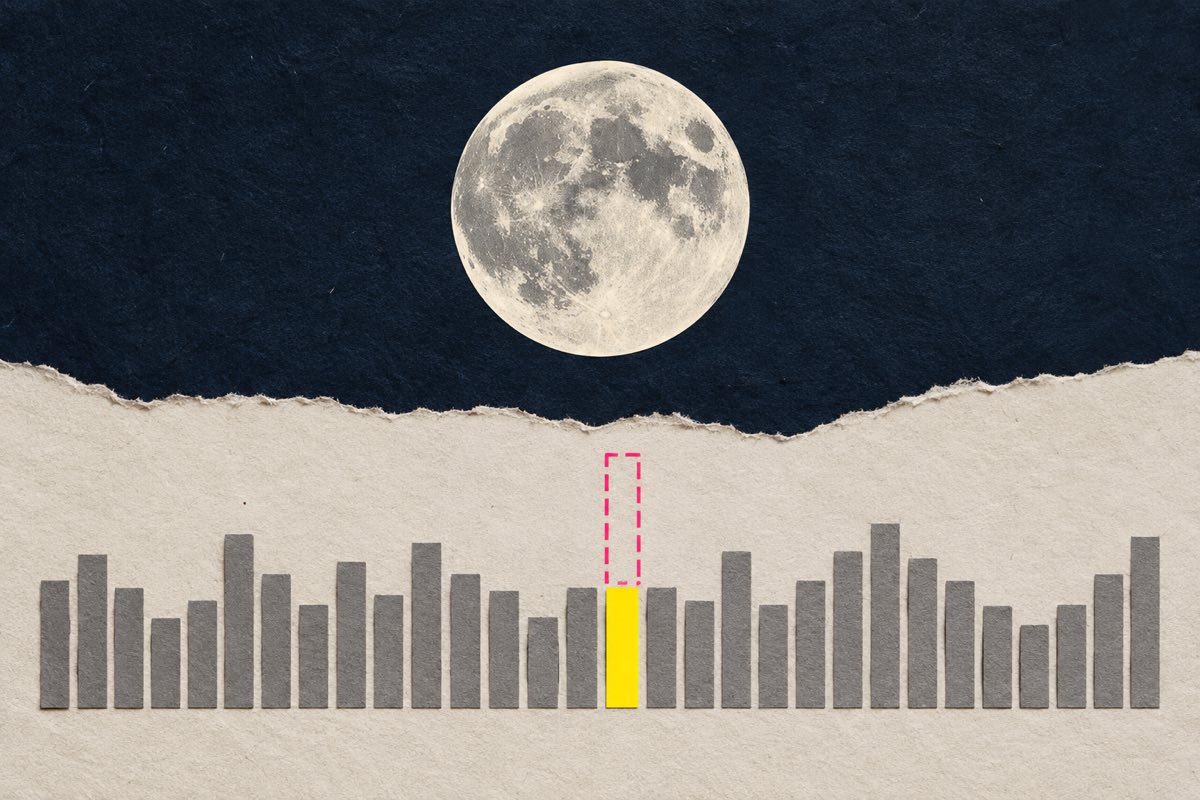
It’s one of the most widely held beliefs among the people best placed to see the evidence. And study after study has failed to find it. Before reading why, look at the month of emergency visits at the top, which is made entirely of random numbers that know nothing about the moon, and see whether the full-moon night stands out.
Try it
Is the full moon busier?
A month of emergency visits, made of pure chance: the moon plays no part. The pink night is the full moon.
This month the full-moon night had 118 visits, 19 more than an average night. A nurse would remember that. Now look at more months.
The belief has an old pedigree
The idea goes back a long way. The word lunatic comes from luna, Latin for the moon, and Roman and medieval writers thought the moon caused madness. Under English law, a lunatic was once defined as someone who had lucid spells and spells of madness that came and went with the phases of the moon. It’s not surprising that a belief so ancient, so vivid and so often repeated should feel like common knowledge.
What the studies found
In 1985, the psychologists James Rotton and Ivan Kelly pooled the results of 37 studies on the moon and behaviour: psychiatric admissions, crimes, crisis calls to helplines, homicides, suicides. They found no link worth the name. Whatever small differences turned up in individual studies vanished when the results were combined.
Later studies have checked many of the specific claims with large sets of records:
- Emergency departments. A 1989 study of trauma cases at an American hospital found no rise at the full moon. Others since, covering far more visits, have found the same.
- Births. A study of more than half a million births found no increase around the full moon, despite the strong belief on maternity wards.
- Psychiatric admissions and crises. No consistent effect, across many countries.
- Crime. Again, no reliable link once enough nights are counted.
The few studies that did find a full-moon effect tended to be small, and their findings didn’t hold up when others looked again. That’s the signature of noise: a result that appears in one small sample and disappears in a large one.
Why it feels so true
If there’s no effect, why do so many experienced people believe in one? Mostly because of how memory works.
- Busy full-moon nights are memorable. A chaotic shift under a full moon gets a story: “of course, it’s a full moon”. A chaotic shift under a half moon is just a bad night, and is forgotten.
- Quiet full-moon nights don’t count. Nobody says “it’s a full moon, and nothing happened”. Those nights never get filed under the moon.
- The belief shapes what you notice. If you expect chaos, you look for it, and with enough people coming through the doors, there is always something.
- The story spreads. Once colleagues share the belief, each memorable night is retold, reinforcing it for everyone.
Psychologists call this illusory correlation: seeing a link between two things because the cases that fit are the ones we remember. In a classic 1967 study, Loren and Jean Chapman found that clinicians “saw” links in patients’ drawings that weren’t there in the data, because the links matched what they expected.
Try it
What’s missing from the evidence?
A paramedic says: “I can name five full-moon shifts this year that were complete chaos. Don’t tell me it’s a myth.” What would you most want to know before agreeing?
Pick one. You’ll see why straight after.
Noise looks like a pattern
There’s a second reason, and it’s the one the toy shows. Any single month of real numbers goes up and down at random. Some nights are busy, some quiet, for no reason at all. On any given month, there’s a fair chance that the full-moon night happens to be one of the busy ones.
Try it
How often chance hands you a “full-moon night”
Suppose the moon does nothing, and the busiest nights of each month fall at random. How likely is it that, over a year, at least one full-moon night lands among a month’s busiest?
With no lunar effect at all, there’s a 72% chance that at least one full moon falls on one of your busiest nights over 12 months, and you’d expect about 1.2 of them. Each one becomes a story. The quiet full moons, and the wild nights under a half moon, don’t.
Over a year of shifts, it’s close to certain that some full moons will land on hectic nights. Each of those becomes evidence. Look at one month and you might see a pattern. Look at many months together and the full-moon nights turn out no busier than any other. That’s why the studies that pool years of data find nothing, while a single shift can feel like proof.
Could the moon affect us at all?
The Moon does real things. Its gravity drives the tides, and moonlight is bright enough to change the behaviour of many animals: some predators hunt more on bright nights, and some prey hide. Corals on the Great Barrier Reef time their mass spawning partly by the lunar cycle.
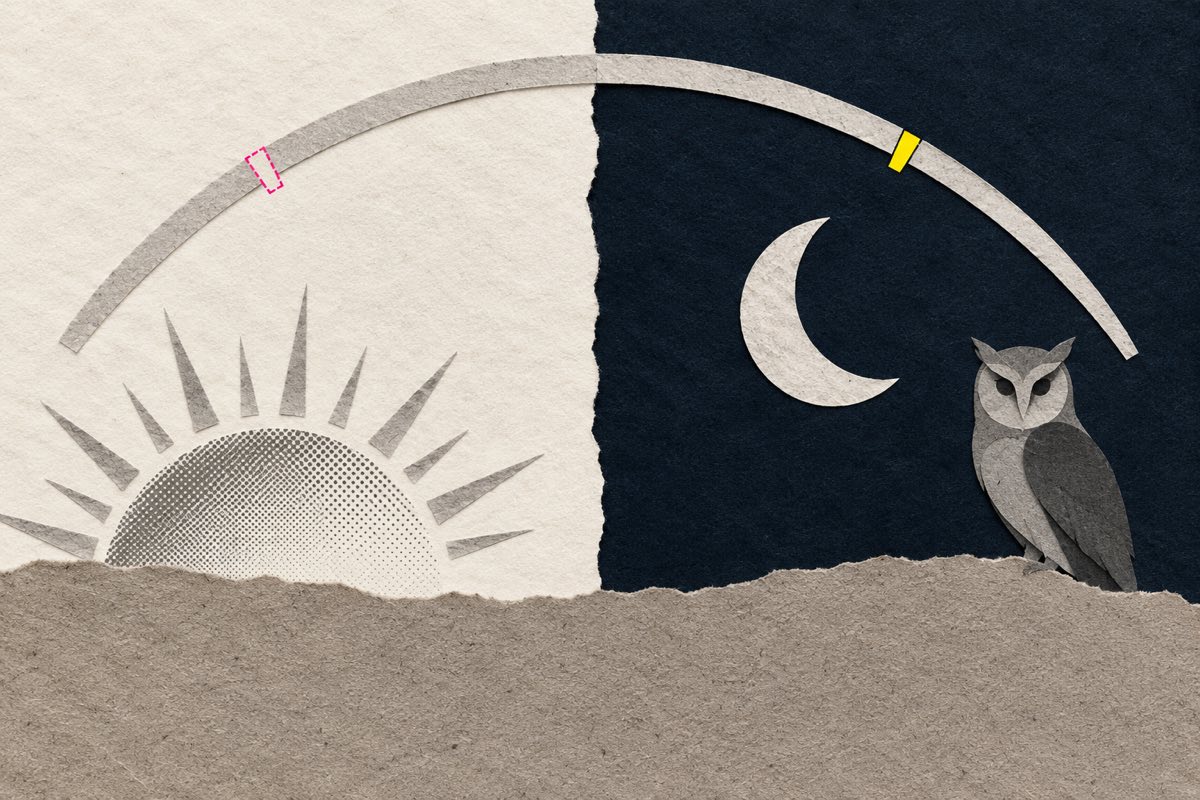
For humans, the most interesting evidence is about sleep. In 2013, Christian Cajochen and colleagues reanalysed data from a sleep lab and found that around the full moon, volunteers took about five minutes longer to fall asleep and slept about twenty minutes less. Other labs tried to repeat it and mostly couldn’t. In 2021, a study of people in Argentina, some in rural communities without electricity and some in a city, and of students in Seattle, found people went to bed later and slept less in the days before a full moon. If there is an effect, it may come from moonlight extending the evening, as it would have done for most of human history.
That’s a far cry from the popular claim. A few minutes’ difference in sleep doesn’t fill a waiting room.
The gravity argument doesn’t work
The most common explanation offered for the full-moon effect is that the Moon pulls on the water in our bodies the way it pulls the sea. It sounds plausible: we’re mostly water, the sea is water, the Moon moves the sea.
It doesn’t transfer. Tides happen because the Moon pulls the near side of the whole Earth more strongly than the far side, across a distance of about 12,700 kilometres, and the oceans flow in response. Across a human body less than two metres tall, that difference in pull is unimaginably small. The astronomer George Abell pointed out that a mosquito landing on your arm exerts more gravitational pull on you than the Moon does. And the Moon’s pull is the same at new moon as at full moon; only the lighting changes. If gravity drove behaviour, the new moon should be just as wild.
Run the test on your own workplace
If you work somewhere that keeps records, you can check the belief yourself. Pull the number of visits, calls or incidents for every night over a year or two. Mark the full-moon nights, which any calendar will give you. Then compare the average for full-moon nights with the average for all the others.
Two warnings. First, do it before you look at which nights felt wild, or memory will pick the comparison for you. Second, expect the full-moon average to come out a little higher or lower than the rest, because any two groups of random nights will differ slightly. The question is whether the difference is bigger than the ordinary night-to-night wobble. In study after study, it isn’t. If yours is, run it again on the next year, because a pattern that’s real will still be there.
What this says about evidence
The full-moon myth is a near-perfect example of how sincere, experienced people can be wrong about patterns in their own work. Nobody is lying. The nights they remember really were chaotic. The mistake is in which nights get remembered, and in not counting the others.
The way out is the same for any claimed pattern: count every case, not the memorable ones. If you think something happens more often under some condition, write down every instance, including the times when nothing happened, and compare. It’s tedious, which is exactly why memory doesn’t do it for us.
Test yourself
The free psychology myths test has the full-moon question along with other popular beliefs about the mind, and the statistics test covers how noise and chance create patterns that aren’t there.
Questions people ask
- Does the full moon affect human behaviour?
- The evidence says no, at least not in any way that shows up in emergency visits, psychiatric admissions, crime or crisis calls. A 1985 review of 37 studies found no meaningful link, and later large studies of hospital and police records have found the same.
- Why do nurses and police believe in the full moon effect?
- Because memory keeps the cases that fit. A chaotic night under a full moon becomes a story; a chaotic night under a half moon is just a bad shift; a quiet full moon is never mentioned. Repeated over a career, that produces a strong and sincere belief.
- Can the Moon’s gravity affect the water in our bodies?
- Not in any meaningful way. Tides happen because the Moon pulls one side of the whole Earth more strongly than the other, across thousands of kilometres. Across a body less than two metres long, the difference is far too small to matter.
- Does the full moon affect sleep?
- Possibly, a little. Some studies have found people take slightly longer to fall asleep or sleep a bit less in the days around a full moon, while others found no effect. If there is one, it’s a matter of minutes, not madness.
- Are more babies born at the full moon?
- No. Studies of hundreds of thousands of births have found no increase around the full moon. It’s another belief kept alive by memorable busy nights on maternity wards.
Sources and further reading
- Rotton, J. and Kelly, I. W. (1985). Much ado about the full moon: A meta-analysis of lunar-lunacy research. Psychological Bulletin, 97(2), 286–306.
- Coates, W., Jehle, D. and Cottington, E. (1989). Trauma and the full moon: A waning theory. Annals of Emergency Medicine, 18(7), 763–765.
- Arliss, J. M., Kaplan, E. N. and Galvin, S. L. (2005). The effect of the lunar cycle on frequency of births and birth complications. American Journal of Obstetrics and Gynecology, 192(5), 1462–1464.
- Chapman, L. J. and Chapman, J. P. (1967). Genesis of popular but erroneous psychodiagnostic observations. Journal of Abnormal Psychology, 72(3), 193–204.
- Casiraghi, L. et al. (2021). Moonstruck sleep: Synchronization of human sleep with the moon cycle under field conditions. Science Advances, 7(5), eabe0465.
- Cajochen, C., Altanay-Ekici, S., Münch, M. et al. (2013). Evidence that the lunar cycle influences human sleep. Current Biology, 23(15), 1485–1488.