Does Venting Your Anger Help? What the Research Says
Punching a pillow, screaming in the car, smashing plates. Studies find venting keeps anger going. What works better, and why the steam-valve idea fails.
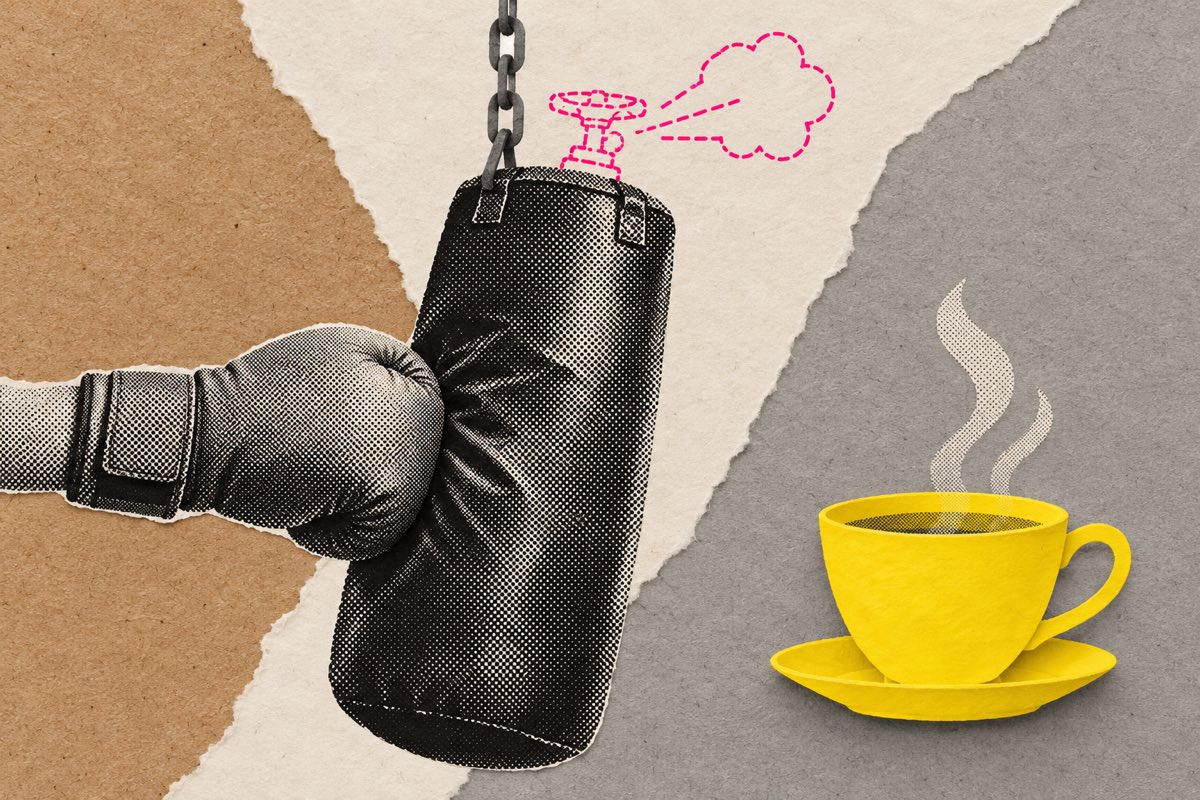
You’re furious. Someone has insulted you, cut you up in traffic or ruined a piece of work. The advice you’ve probably heard is to let it out: punch a pillow, scream in the car, go for a hard run, get it off your chest. Bottling it up, the thinking goes, only makes it worse.
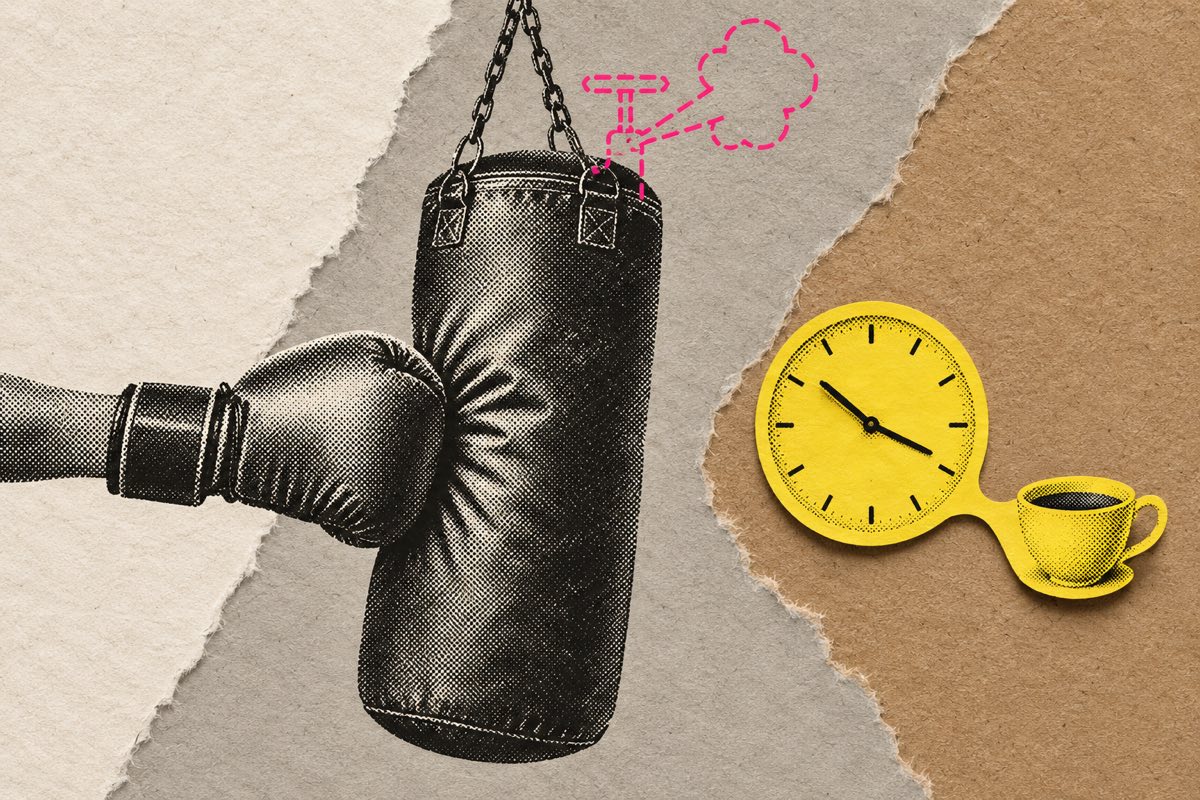
It’s a popular idea, and an industry has grown up around it. There are now “rage rooms” where you pay to smash plates and old printers with a baseball bat. But when psychologists have put venting to the test, it has tended to keep people angry, not calm them down. The toy at the top shows the shape of what they found: try venting against simply waiting.
Try it
Does letting it out make anger go away?
Someone has made you furious. Pick what you do, then move the clock.
After 15 minutes of “hit a punching bag”, anger is at 54 out of 100. The steam-valve idea says venting would have it at 12. Venting kept rehearsing what made you angry.
The steam-valve idea
The belief that venting helps is called catharsis, from a Greek word for cleansing. Aristotle used it for the way tragedy purges the audience’s emotions. In the 1890s, Sigmund Freud and his colleague Josef Breuer described emotions as a kind of pressure that builds up inside and needs to be released, or it will find its way out in some other, unhealthy form.
The image is a pressure cooker: let the steam out and the pressure drops. It’s intuitive, and it spread into popular advice about anger, from self-help books to cartoons of steam coming out of people’s ears.
What happened when it was tested
In a well-known experiment published in 2002, the psychologist Brad Bushman made several hundred students angry. Each wrote an essay, then got it back with harsh, insulting comments, apparently from another student (“This is one of the worst essays I have read!”). Then the students were split into three groups:
- One group hit a punching bag while thinking about the person who insulted them, with a photo of that person in front of them.
- One group hit a punching bag while thinking about getting fit.
- One group sat quietly for a couple of minutes.
Afterwards, everyone rated how angry they felt, and then got a chance to blast the person who’d insulted them with unpleasant noise through headphones.
The venting group, hitting the bag while thinking of their insulter, felt the angriest and were the most aggressive. The group that sat quietly were the least angry and least aggressive. The punching-for-fitness group was in between. Venting didn’t drain the anger. It rehearsed it.
Bushman had found something similar earlier. In a 1999 study, people who’d read an article claiming that venting helps were more likely to want to hit a punching bag when angered, and then more aggressive afterwards. Believing in catharsis made people act on their anger.
The big picture, from 154 studies
One study could be a fluke. In 2024, Sophie Kjærvik and Brad Bushman pooled 154 studies of activities people use to manage anger, with more than 10,000 participants between them.
Try it
What cools you down fastest?
A 2024 review pooled 154 studies of activities people use when they’re angry. Which kind reliably reduced anger?
Pick one. You’ll see why straight after.
The pattern was clear. Activities that lower arousal, such as slow breathing, progressive muscle relaxation, mindfulness and slow-paced yoga, reliably reduced anger, in the lab and in everyday life, and across ages and backgrounds. Activities that raise arousal, such as running, cycling or hitting things, didn’t reliably reduce anger, and some increased it. Exercise has plenty of benefits for health and mood over time. It just isn’t a pressure valve.
Why venting backfires
- It keeps you thinking about what made you angry. Every punch is another replay of the insult, and dwelling on it feeds the feeling. Psychologists call this rumination, and it’s one of the most reliable ways to keep a bad mood going.
- It keeps your body in fight mode. Your heart rate, blood pressure and breathing stay high, which is exactly the state anger lives in. Anger and physical arousal feed each other.
- It practises aggression. Acting out anger, even at a pillow, rehearses doing it, and makes the next outburst come more easily.
- It feels good, briefly. That’s what makes venting seductive. A burst of release feels like relief, which teaches you to do it again, but the anger is still there afterwards, often more of it.
What helps instead
Anger is a surge, and like most surges, it fades on its own if you stop feeding it. What helps is anything that lowers the heat and breaks the replay.
- Calm your body. Slow your breathing, with a longer breath out than in. Relax your shoulders and jaw. Physical calm makes it harder to stay furious.
- Wait. Give it time, and do something else meanwhile. Counting to ten is old advice that works partly because it buys time.
- Distract yourself. Something absorbing but not aggressive: a puzzle, music, a walk, a task that needs attention.
- Change the story. Ask whether there’s another way to see what happened. Was the driver rushing to a hospital? Was the comment as harsh as it felt? Psychologists call this reappraisal, and it’s one of the most effective ways of managing emotion.
- Deal with the cause when you’re calm. If there’s a real problem, say so clearly once the surge has passed. That’s assertiveness, which is very different from venting.
Is talking it through venting?
It depends on how you talk.
Try it
What about talking it through?
You’re furious about something a colleague did, and you phone a friend. Which kind of conversation is more likely to leave you calmer?
Pick one. You’ll see why straight after.
Talking to someone about what happened can help a great deal, when it helps you understand it, see it differently, or decide what to do. That’s problem solving. Going over the grievance again and again with someone who agrees how outrageous it was is something else. The psychologist Amanda Rose called it co-rumination, and in studies of teenagers it was linked to closer friendships but also to more anxiety and low mood.
Writing works in a similar way. James Pennebaker’s research found that writing about difficult experiences, trying to make sense of them, could improve wellbeing over time. That isn’t venting either. It’s understanding. A furious message typed and sent in the heat of the moment is the opposite.
In an argument with someone you love
Anger with a partner, a parent or a close friend is its own case, because the person is right there and you can’t just walk off for good. The relationship researcher John Gottman describes a state he calls flooding: in a heated argument, heart rate climbs, often past about 100 beats a minute, and the capacity to listen, think and be kind drops sharply. People say things they don’t mean, or shut down entirely.
His advice is unglamorous and well supported: when you notice you’re flooded, agree to take a break of at least twenty minutes, and spend it doing something genuinely calming, not rehearsing your case. Then come back and finish the conversation. It works because it does exactly what the venting research recommends. It lowers arousal, stops the replay, and saves the actual problem for a calmer head.
The break only works if both people trust that it’s a pause and not an escape. Saying “I need twenty minutes, and then I want to sort this out” makes all the difference.
So should you bottle it up?
No, and this is where the venting myth misleads twice. The choice isn’t between exploding and suppressing. Pretending you’re not angry while your jaw clenches doesn’t work well either, and constantly swallowing grievances can damage relationships.
The research points to a third path: notice the anger, let your body calm down, and then, if something needs to change, say so clearly and without attack. Anger can be useful information that something matters to you, and sometimes that something needs fixing. Venting just isn’t the best way to use it.
Test yourself
The free psychology myths test has the venting question alongside other popular beliefs about the mind, and the communication style test shows whether you tend to be assertive, passive, aggressive or passive-aggressive when you’re annoyed.
Questions people ask
- Is venting anger healthy?
- Not in the sense people usually mean. Hitting things, shouting or replaying what made you angry tends to keep anger going rather than draining it. Expressing anger calmly and clearly to deal with a problem is different, and can be healthy. Rehearsing it on your own usually isn’t.
- Do rage rooms work?
- There’s little evidence they reduce anger, and the research on venting suggests smashing things while angry could keep the feeling going. They may be fun as an activity in a calm mood. As a cure for anger, the evidence points the other way.
- What actually helps when you’re angry?
- Lowering your arousal: slow breathing, relaxing your muscles, stepping away, or a calm distraction until the surge passes. Then, if there’s a real problem, deal with it once you’re calmer. A large 2024 review found that calming activities reliably reduced anger across many studies.
- Does exercise help with anger?
- Exercise is good for mood and health over time, but a hard workout while angry didn’t reliably reduce anger in the research, because it keeps your body’s arousal high. A walk or gentle activity that calms you down is more likely to help in the moment.
- Where did the idea of venting come from?
- From the idea of catharsis, which goes back to Aristotle and was developed by Sigmund Freud and Josef Breuer in the 1890s. It pictures emotion like steam that builds up and must be released. The image is intuitive, but experiments since the 1950s haven’t supported it for anger.
Sources and further reading
- Bushman, B. J. (2002). Does venting anger feed or extinguish the flame? Catharsis, rumination, distraction, anger, and aggressive responding. Personality and Social Psychology Bulletin, 28(6), 724–731.
- Kjærvik, S. L. and Bushman, B. J. (2024). A meta-analytic review of anger management activities that increase or decrease arousal: What fuels or douses rage? Clinical Psychology Review, 109, 102414.
- Bushman, B. J., Baumeister, R. F. and Stack, A. D. (1999). Catharsis, aggression, and persuasive influence: Self-fulfilling or self-defeating prophecies? Journal of Personality and Social Psychology, 76(3), 367–376.
- Rose, A. J. (2002). Co-rumination in the friendships of girls and boys. Child Development, 73(6), 1830–1843.
- Pennebaker, J. W. and Beall, S. K. (1986). Confronting a traumatic event: Toward an understanding of inhibition and disease. Journal of Abnormal Psychology, 95(3), 274–281.
- Breuer, J. and Freud, S. (1895). Studies on Hysteria.