Did Einstein Fail Maths? Where the Myth Came From
Einstein taught himself calculus by 15 and aced maths at school. Why does everyone think he failed? An entrance exam, a flipped grade scale and a 1935 column.
There’s a story told in classrooms everywhere to encourage students who are struggling: Albert Einstein, the greatest scientist of the twentieth century, failed maths at school. If he could recover, so can you.
It’s a lovely story, and it isn’t true. Einstein was very good at maths from an early age. But the myth didn’t come from nowhere, and where it came from is a neat lesson in how to read sources, and how a fact can be true and still mislead. Step through the timeline at the top for the real order of events.
Try it
When did it really happen?
Step through the moments behind the myths.
1879: Einstein is born in Ulm, in Germany.
What Einstein was really like at maths
By his own account and those of people who knew him, Einstein’s love of maths started early. At about 12, he was given a geometry book and worked through it on his own; he later called it his “holy geometry booklet”, and remembered the clarity and certainty of its proofs as a revelation. An uncle and a family friend, a medical student called Max Talmud, fed him more books. Before he was 15, he said, he had taught himself differential and integral calculus.
His school reports from the Luitpold Gymnasium in Munich show good marks in maths and Latin. What he didn’t like was the school itself: its drill, its rote learning and its military discipline. He left at 15, without finishing, to join his family, who had moved to Italy.
The exam he did fail
In 1895, Einstein sat the entrance exam for the Swiss Federal Polytechnic in Zurich, now ETH Zurich, one of the best technical universities in Europe.
Try it
How old was he?
Einstein did fail one entrance exam, for the Swiss Federal Polytechnic in Zurich. The usual age for candidates was about 18. How old was he when he sat it?
Drag the dot to your guess, then lock it in. Nothing is revealed until you do.
He was 16, about two years younger than most candidates, and he hadn’t finished secondary school. He did very well in the maths and physics sections. He did poorly in the general sections, which included French, chemistry and biology, and didn’t pass overall. The Polytechnic’s head was impressed enough by his science to suggest he finish school first and try again, so he spent a year at a progressive school in Aarau, Switzerland, which he loved. He entered the Polytechnic in 1896.
So he did fail an exam. But not because of maths, and he was two years ahead of schedule when he did.
The grades that flip
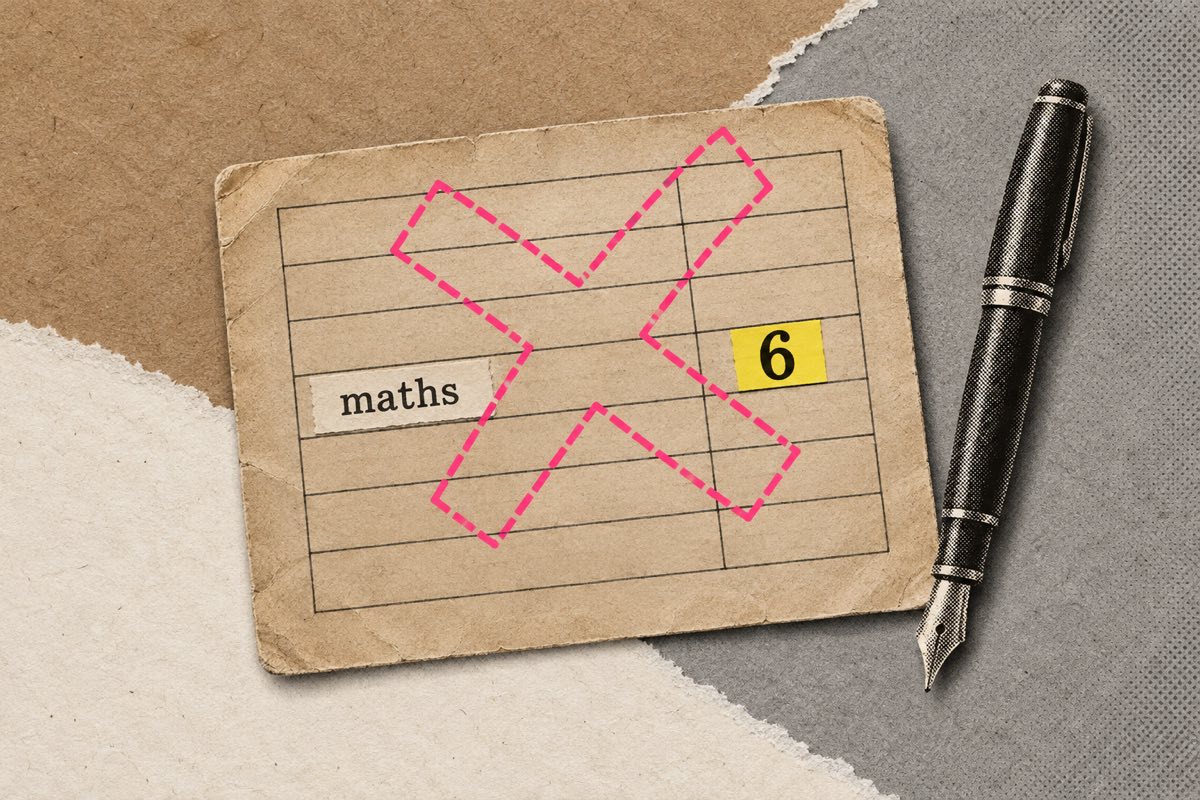
There’s a second likely source of the myth. At the Aarau school, marks ran from 1 to 6, with 6 the best. Einstein’s leaving certificate, which survives, shows 6s in algebra and geometry, high marks in physics, and his weakest grade, a 3, in French.
Try it
Read the school report
Einstein’s leaving certificate from his Swiss school in 1896 shows 6 in algebra, 6 in geometry and 3 in French. At that school, marks ran from 1 to 6. What do you need to know before deciding what this says about his maths?
Pick one. You’ll see why straight after.
In much of Germany, the scale runs the other way: 1 is the best grade and 6 a fail. Anyone reading his Swiss certificate with German grades in mind would see a row of near-fails in maths. Some accounts also say that the Aarau school itself changed its scale around his time, which would have made old and new records easy to confuse. Whatever the exact route, a certificate full of top marks is about as far from failing maths as it’s possible to get.
The newspaper column
The myth got its biggest boost in 1935, when the popular feature Ripley’s Believe It or Not! ran the claim that the greatest living mathematician had failed in mathematics. It was syndicated across hundreds of American newspapers.
Einstein, then at Princeton, was shown the clipping by a rabbi and is reported to have laughed. He said he had never failed in mathematics, and that before he was fifteen he’d mastered calculus. The correction didn’t travel nearly as far as the original claim. They rarely do.
The miracle year, and a patent office
After graduating in 1900, Einstein struggled to find an academic job. His professors found him clever but insubordinate, and he skipped lectures, relying on the excellent notes of his friend Marcel Grossmann. In 1902 he took a job as a technical expert, third class, at the Swiss patent office in Bern, evaluating inventions.
Then, in 1905, while still at the patent office, he published four papers that changed physics: on the photoelectric effect, which later won him the Nobel Prize; on Brownian motion, which helped confirm that atoms exist; on special relativity; and the short paper that contains E = mc². It’s called his annus mirabilis, his miracle year. It wasn’t the work of someone who had struggled with mathematics.
A grain of truth, in the right place
The honest version of the story has a twist. Einstein wasn’t a professional mathematician, and for the hardest problem of his career, he needed help.
When he was developing general relativity around 1912, he realised he needed a branch of geometry, for curved spaces, that he hadn’t studied. He turned to the same friend, Marcel Grossmann, by then a mathematics professor, who pointed him to the work of Bernhard Riemann and others. Einstein wrote at the time that the work had given him great respect for mathematics, whose subtler parts he’d previously treated as a luxury.
So if you want a true story to encourage a struggling student, there is one. It isn’t “Einstein failed maths”. It’s “Einstein reached the edge of what he knew, admitted it, and asked a friend for help”.
Why we want it to be true
The myth spreads because it’s useful. It tells struggling students that early failure doesn’t decide anything, and that genius can hide behind bad grades. That message is often true of other people. It’s just not true of Einstein.
What is true is that Einstein clashed with rigid teaching. He disliked rote learning and drill, argued with teachers and, at the Polytechnic, irritated professors who would later decline to recommend him for jobs. “Hated being told what to do” is a more accurate story than “bad at maths”, and arguably a more useful one: you can be excellent at a subject and still do badly in a system that teaches it badly.
If you want true stories of slow starts
There are real ones, and they make the point better than a myth does.
- Charles Darwin dropped out of medical school in Edinburgh, and his father told him he cared for nothing but shooting, dogs and rat-catching, and would be a disgrace to himself and his family. He went on a five-year voyage on HMS Beagle instead, and it changed biology.
- Winston Churchill was an unhappy, middling pupil at Harrow and needed three attempts to pass the entrance exam for the Royal Military College at Sandhurst.
- Thomas Edison spent only a few months at school before his mother took him out and taught him at home, after, by his own account, a teacher called him “addled”.
Each of these is documented, and each carries the message people want from the Einstein story: a poor start at school isn’t a verdict on a life. It’s just better to tell the true version, because a student who later discovers the Einstein story is false may also decide the lesson was.
How to check a story like this
The Einstein myth is a model for checking any striking fact about a famous person:
- Look for the primary source. Einstein’s school records and certificate survive and have been published. They settle the question.
- Check what the numbers mean. A grade, a measurement or a date can mean different things in different countries and times. A 6 at Aarau isn’t a 6 in Munich.
- Find when the story first appeared. If it shows up decades later in a newspaper feature, be suspicious.
- Ask who benefits from the story. A myth that’s inspiring or flattering spreads faster than a dull truth, whatever the evidence says.
The free history myths test has the Einstein question alongside nineteen other things people get wrong about the past, and the study myths test covers what really helps people learn.
Questions people ask
- Did Einstein fail maths at school?
- No. His school records in Munich and Switzerland show strong marks in maths, and his 1896 leaving certificate gives him the top grade, 6, in algebra and geometry. By his own account he had taught himself calculus before he turned 15.
- What exam did Einstein fail?
- The entrance exam for the Swiss Federal Polytechnic in Zurich, in 1895. He was 16, about two years younger than most candidates. He did very well in maths and physics but poorly in the general sections, including French, so he finished school in Aarau first and was admitted the following year.
- Where did the myth that Einstein failed maths come from?
- Probably from several things at once: the failed entrance exam, a Swiss grading scale where 6 is best (the reverse of Germany’s), and a 1935 Ripley’s Believe It or Not! feature claiming the greatest living mathematician had failed maths. Einstein, shown it, said he never had.
- Was Einstein good at maths compared with mathematicians?
- He was a superb mathematical physicist, but not a professional mathematician, and he knew it. For general relativity he needed advanced geometry he hadn’t studied, and he worked through it with his friend Marcel Grossmann. He later said that working on it gave him great respect for mathematics.
- Why do people believe Einstein failed maths?
- Because it’s an encouraging story: it suggests early failure doesn’t decide anything and that genius can hide behind bad grades. That message is often true of other people. It just isn’t true of Einstein, who was a strong student who disliked rote teaching.
Sources and further reading
- Isaacson, W. (2007). Einstein: His Life and Universe. Simon & Schuster.
- Pais, A. (1982). Subtle Is the Lord: The Science and the Life of Albert Einstein. Oxford University Press.
- Einstein, A. (1949). Autobiographical notes. In Schilpp, P. A. (ed.), Albert Einstein: Philosopher-Scientist. Library of Living Philosophers.
- The Collected Papers of Albert Einstein, Vol. 1: The Early Years, 1879–1902 (1987). Princeton University Press. (School records and the Aarau certificate.)
- Calaprice, A. (ed.) (2011). The Ultimate Quotable Einstein. Princeton University Press.