Did People in the Middle Ages Really Die at 30?
Medieval life expectancy was around 30 to 35, yet adults often lived into their 60s. How child deaths drag down an average, and what the number really means.
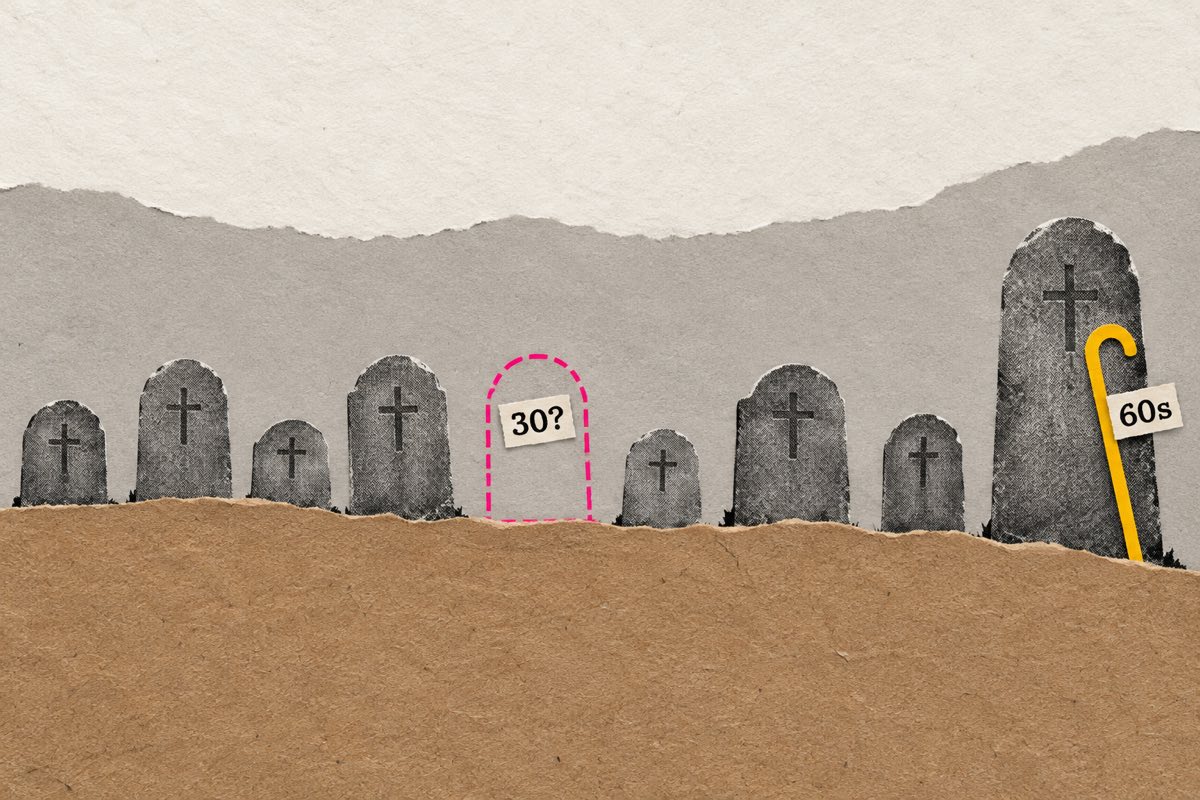
You’ve probably heard it: people in the Middle Ages died at around 30. Sometimes it comes with a picture of a weathered peasant who looks sixty and is really twenty-five. It’s repeated in documentaries, history lessons and arguments about how lucky we are now.
The number is real. It just doesn’t mean what it sounds like. Most adults in the Middle Ages lived well past 30, and plenty reached 60 or 70. Before reading why, try the village at the top: set how many children die young, and watch the average move while the adults’ ages don’t.
Try it
Did people in the Middle Ages die at 30?
A hundred people born in a village. Set how many die as children.
Life expectancy at birth: 35. But the adults here typically died at about 62. 45 of 100 died before 5, and those deaths drag the average down; almost nobody died at 35.
What “life expectancy at birth” measures
Life expectancy at birth is the average age at death of everyone born, babies included. And in the Middle Ages, a great many people died as babies and small children. Historians’ estimates vary by place and century, but in many places something like a third of children, and in bad times close to half, died before they were about ten.
Picture 100 people born in a village. Say 45 die before their fifth birthday, at an average age of about 2. The other 55 live to an average of about 62. The average across all 100 is:
(45 × 2 + 55 × 62) ÷ 100 ≈ 35
So the village’s life expectancy is 35, and yet almost nobody in it died at 35. The babies died long before; the adults died long after. The average sits in a gap where almost nobody is.
Try it
Build a life expectancy
A hundred people born in a village. Some die as small children, at about two on average; the rest live to an adult age you choose. What’s the life expectancy at birth?
With 40 children in 100 dying young, life expectancy at birth is 37, though the adults typically die around 60. Almost nobody actually dies at 37: it’s an average of two very different groups. Bring child deaths down and watch it jump while the adults don’t change at all.
That’s the whole trick. An average of two very different groups can describe neither of them. This is exactly the kind of case where the median, or better still a description of the two groups separately, tells you more. There’s more on this in mean versus median.
How long did adults really live?
Once someone had survived childhood, their prospects were far better than the headline number suggests. One of the few groups with good records is the English landholding nobility. Demographers who studied them, such as T. H. Hollingsworth, estimated that a man who reached 21 in the 13th century could typically expect to live into his early sixties.
Monasteries also kept careful records of when their monks died, and they show something important: adult life was still risky. In the 15th century, monks at Westminster Abbey and Canterbury, well fed and well housed, often died in their forties and fifties, many of them in waves of plague. So medieval adults didn’t live as long as we do. But the gap was nothing like the gap the “died at 30” figure implies.
The individual lives that history records point the same way:
- Bede, the English monk and historian, died around 62, in 735.
- Hildegard of Bingen, abbess, composer and writer, died at about 81, in 1179.
- Eleanor of Aquitaine died at about 82, in 1204.
Try it
How long did a medieval queen live?
Eleanor of Aquitaine was born around 1122, was queen of France and then of England, and survived two husbands, a long imprisonment and several crusading journeys. About how old was she when she died?
Drag the dot to your guess, then lock it in. Nothing is revealed until you do.
Rich and famous people did better than peasants, of course, as they still do. But the pattern isn’t that a few rare individuals reached old age against all odds. It’s that old age was common for those who got through childhood, and childhood was the dangerous part.
How do historians know?
Medieval people didn’t publish life tables, so the figures are reconstructions, and it’s worth knowing where they come from.
- Family records of the rich. Noble and royal families recorded births, marriages and deaths, because inheritance depended on them. That’s why the best numbers for the Middle Ages are for landholders, who are not a typical sample.
- Institutions. Monasteries recorded the deaths of their members, and some manors recorded tenants and the payments due when one died.
- Skeletons. Archaeologists estimate age at death from bones and teeth. Children’s ages are fairly easy to read; older adults’ are harder, and older methods tended to underestimate them, which has pushed some estimates of ancient lifespans too low.
- Parish registers. In England, churches were ordered to record every baptism, marriage and burial from 1538. From then on, demographers can reconstruct whole communities, and those reconstructions show the same pattern: dangerous childhoods, and plenty of people living into their sixties and beyond.
Each source has gaps, and the numbers vary by region and century. But they agree on the shape, and the shape is not “everyone dies at 30”.
What killed people?
If the adults lived into their sixties, what made medieval life so dangerous? Mostly the things that killed children: infections. Without any knowledge of germs, without clean water or vaccines, diseases like diarrhoea, measles and smallpox killed huge numbers of infants. Childbirth itself was dangerous for babies and mothers alike.
Adults faced plenty of risk too: injuries that a modern hospital would treat easily, infected wounds, famine in bad harvest years, war, and above all epidemics. The Black Death of 1347 to 1351 killed perhaps a third to a half of Europe’s population, and plague returned again and again for centuries.
So the right picture isn’t that people grew old at 30. It’s that life was uncertain at every age, most of all at the start.
The same trap, in other places
The confusion isn’t only about the Middle Ages.
Ancient Rome had a life expectancy at birth of perhaps 20 to 30, again mostly because of child deaths. Romans who reached adulthood often lived into their fifties and sixties. For much of the Republic, the minimum legal age to be consul, the highest office, was 42. A society where people were old at 30 wouldn’t set its top job’s minimum age in the forties.
Britain in 1900 had a life expectancy at birth of under 50. Today it’s over 80. A large part of that rise came from fewer children dying, thanks to clean water, sewers, vaccines and later antibiotics, rather than from adults living to extreme old ages. The maximum human lifespan has barely moved. What’s changed is how many people get to use it.
Poor countries today sometimes have life expectancies at birth in the fifties or low sixties. That doesn’t mean adults there age faster. It usually means too many children die before five, which is why child survival is one of the most powerful things global health programmes work on.
So were people old at 40?
Not in the way the myth suggests. Medieval writers drew on ideas going back to the Bible’s “threescore years and ten”, seventy years, as the measure of a full life, and medieval theories of the “ages of man” put old age in the fifties or sixties. People knew what old age looked like, because they saw it in their grandparents.
What was different was how much harder it was to get there. A medieval family could expect to bury some of its children, and adults faced risks at every age that modern medicine has mostly removed. The low average is a record of those losses, especially of children, rather than a sign that everyone aged faster.
Why the myth sticks
It’s a striking statistic, it’s technically true, and it makes a good contrast with today. It also feeds a story about the past as short, brutish and primitive, which makes us look good. And the subtlety, that an average can describe nobody, is exactly the kind of thing that gets lost when a number is passed on.
The lesson travels well. Whenever you hear an average about people, ask: is this the typical person, or is it an average of very different groups? A life expectancy of 35, an average income, an average house price: each can sit in a gap where almost nobody is.
Try it
Slide the number of child deaths down to zero in the village toy. Life expectancy jumps by more than twenty years, and the adults’ typical age at death doesn’t move at all.
The free history myths test has more myths about the past, and the statistics test tests the averages behind this one.
Questions people ask
- What was the life expectancy in medieval times?
- At birth, roughly 30 to 35 in much of medieval Europe, though estimates vary by place and period. That low figure is mostly due to child deaths. For someone who reached adulthood, the expected age at death was far higher, often in the 50s or 60s.
- Did medieval people really die at 30?
- Some did, of disease, childbirth, war or accidents, but 30 wasn’t a normal age to die. Records of English landholders suggest a man who reached 21 could typically expect to live into his early 60s. The famous figure of 30 is an average that includes many babies who died.
- Why was child mortality so high in the Middle Ages?
- Infections spread easily, and there were no vaccines, antibiotics or knowledge of germs. Diarrhoea, measles, smallpox and other diseases killed many infants, along with famine and complications of birth. In many places a third or more of children may have died before about ten.
- How long did people live in ancient Rome?
- Life expectancy at birth was probably between 20 and 30, again mostly because of child deaths. Romans who reached adulthood often lived into their fifties and sixties. The minimum legal age for the top political office, consul, was 42 for much of the Republic.
- What is the difference between life expectancy at birth and lifespan?
- Life expectancy at birth is an average across everyone born in a period. Lifespan is how long a human body can last, which has barely changed: people have reached their 70s, 80s and 90s throughout recorded history. What has changed is how many people get the chance to.
Sources and further reading
- Hollingsworth, T. H. (1969). Historical Demography. Cornell University Press.
- Harvey, B. (1993). Living and Dying in England, 1100–1540: The Monastic Experience. Clarendon Press.
- Orme, N. (2001). Medieval Children. Yale University Press.
- Frier, B. W. (2000). Demography. In Bowman, A., Garnsey, P. and Rathbone, D. (eds), The Cambridge Ancient History, Vol. XI. Cambridge University Press.
- Office for National Statistics. How has life expectancy changed over time? (2015).
- Roser, M., Ortiz-Ospina, E. and Ritchie, H. Life expectancy. Our World in Data.