The Bat and Ball Problem: Why Most People Get It Wrong
A bat and ball cost $1.10, and the bat costs $1 more. Most people, even at MIT and Harvard, say the ball is 10 cents. Why, and how to catch yourself.
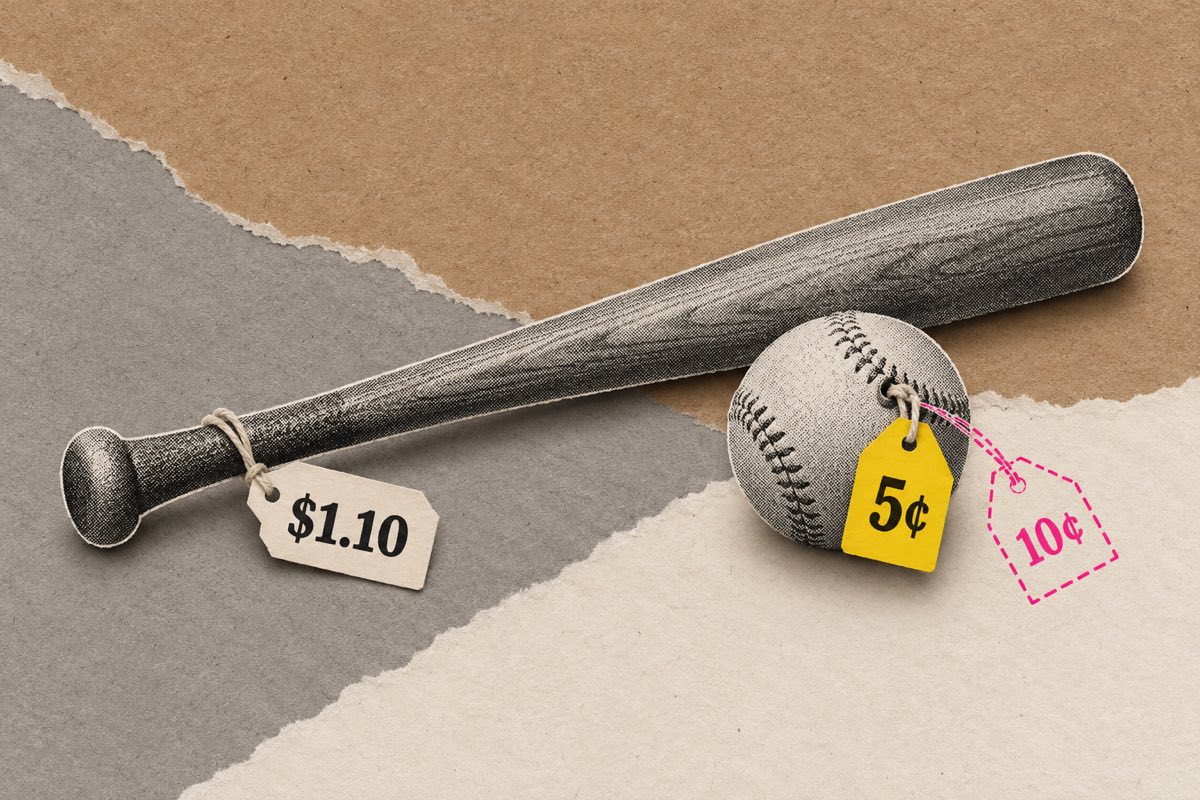
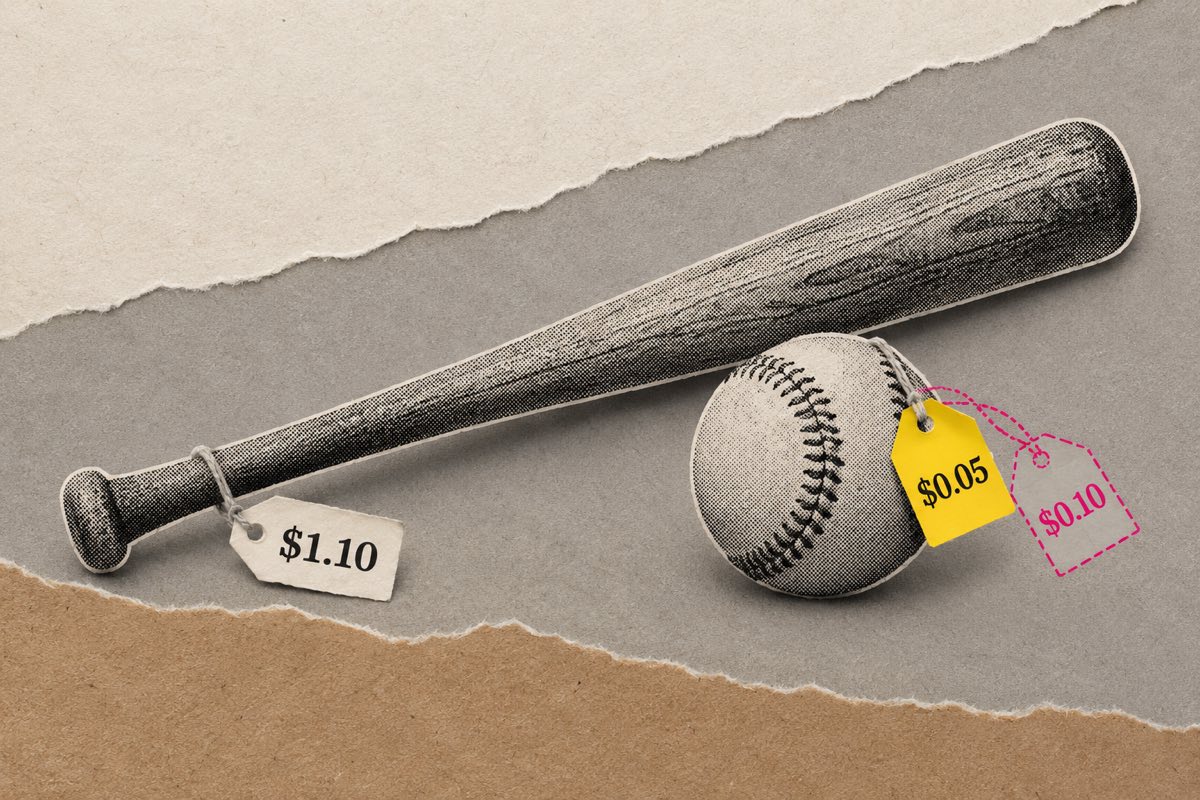
A bat and a ball cost $1.10 in total. The bat costs $1.00 more than the ball. How much does the ball cost?
If an answer popped into your head straight away, it was probably 10 cents. It pops into almost everyone’s. It feels obvious, almost too easy to be a puzzle. And it’s wrong.
Try it
The bat and the ball
Together they cost $1.10, and the bat costs $1.00 more than the ball. Slide the ball’s price until the total is right.
Ball 10¢ + bat $1.10 = $1.20. Too much. Keep sliding.
Checking the 10-cent answer
Put the answer back into the question. If the ball costs 10 cents, the bat costs $1.00 more, which is $1.10. Together that’s $1.20, not $1.10.
The right answer is 5 cents. The ball is 5 cents, the bat is $1.05, and together they make $1.10. The bat costs exactly $1.00 more than the ball. Slide the ball’s price in the toy at the top and watch the total: you can feel how hard the 10-cent answer pulls, even when the bar shows it doesn’t fit.
If you like algebra, the working is short. Call the ball x. The bat is x + $1.00. Together, x + x + $1.00 = $1.10, so 2x = $0.10, and x = $0.05.
Nothing about this needs advanced maths. The puzzle is hard for a different reason, and that reason is the interesting part.
Smart people get it wrong too
The problem was made famous by the psychologist Shane Frederick, who in 2005 included it in a three-question test he called the Cognitive Reflection Test. He gave it to thousands of people, many of them students at leading universities.
More than half of the students at Harvard, MIT and Princeton gave the 10-cent answer. At some other universities, a large majority did. This isn’t because they couldn’t do the sum. If you ask anyone to work out 5 cents plus $1.05, they get $1.10. It’s because the sum never got done. The answer arrived first, felt right, and was handed in.
Frederick’s other two questions work the same way.
Try it
The second question
If it takes 5 machines 5 minutes to make 5 widgets, how long would it take 100 machines to make 100 widgets?
Pick one. You’ll see why straight after.
Try it
The third question
In a lake there’s a patch of lily pads. Every day, the patch doubles in size. If it takes 48 days to cover the whole lake, how many days does it take to cover half the lake?
Drag the dot to your guess, then lock it in. Nothing is revealed until you do.
Each has an answer that arrives instantly and fits a pattern: split $1.10 into $1 and 10 cents; match 5, 5, 5 with 100, 100, 100; halve 48. Each takes only a moment of checking to see through. And each catches a large share of very capable people.
Fast thinking and slow thinking
Psychologists often describe two modes of thinking, an idea Daniel Kahneman made famous in Thinking, Fast and Slow:
- Fast thinking (sometimes called System 1) is automatic, effortless and immediate. It’s what reads a face, finishes a familiar sentence or tells you 2 + 2 is 4.
- Slow thinking (System 2) is deliberate and effortful. It’s what multiplies 17 by 24, checks a claim or works through a problem step by step.
Fast thinking is right most of the time, which is why we rely on it. The bat and ball problem is built so that fast thinking produces a confident wrong answer, and slow thinking has to step in to check it. Most people don’t notice there’s anything to check, because the answer feels so right.
It’s worth being precise about what the problem shows. It isn’t that intuition is bad. Intuition is how experts make fast, excellent decisions in their own field: a chess grandmaster sees the right move, a doctor spots a sick child across a room. It’s that intuition can be confidently wrong in situations it hasn’t been trained on, and it doesn’t come with a warning light.
The mind may notice anyway
There’s an intriguing twist. In 2013, the psychologist Wim De Neys and colleagues compared people answering the bat and ball problem with people answering a version without the trap, in which the bat simply costs $1 and the ball some amount. People who gave the wrong 10-cent answer on the tricky version were less confident in it than people answering the easy version were in theirs.
In other words, part of the mind seems to register that something is off, even when the person goes with the quick answer anyway. That’s hopeful. It suggests that the habit to build isn’t a new kind of intelligence, but paying attention to a small feeling of doubt that’s already there.
Why it matters beyond puzzles
Frederick found that people who did better on his three questions also made different decisions about money and risk. For example, they were more willing to wait for a larger payment later rather than take a smaller one now, and more willing to take a gamble with a higher expected value. Other researchers have found that cognitive reflection predicts less belief in some kinds of misinformation and more accurate judgements in some tasks.
The connection isn’t that people who solve the puzzle are cleverer. It’s that they’re in the habit of checking answers that come too easily. That habit is useful whenever a situation offers a tempting quick answer: a price that looks like a bargain, a headline that confirms what you already think, a statistic that seems to settle an argument.
More traps with the same shape
Once you know the trick, you start to see it in other famous questions. They all offer an answer that fits the surface of the question while ignoring a detail.
How many animals of each kind did Moses take on the ark? Most people say two. It was Noah who built the ark, not Moses. In a 1981 study, Thomas Erickson and Mark Mattson found that most people answer without noticing the wrong name, even when warned that some questions contain errors. It’s called the Moses illusion, and it works because Moses is close enough to Noah to pass.
A farmer has 17 sheep. All but 9 die. How many are left? The quick answer is 8, from subtracting 9 from 17. But “all but 9 die” means 9 survive.
If you’re running a race and pass the person in second place, what place are you in? First feels right. You’re now second: you took their place, and the leader is still ahead.
None of these needs knowledge. They need a pause, and a second look at the exact words. That pause is cheap, and it’s the whole skill the bat and ball problem is measuring.
How to catch yourself
You can’t switch off fast thinking, and you wouldn’t want to. But you can learn where it’s likely to trip you up, and build a short habit.
- Notice when an answer comes too easily on something that’s meant to be tricky. Puzzles, exam questions and sales pitches are often designed so that the obvious answer is the trap.
- Check the answer against the question. Put it back in. If the ball were 10 cents, would the total be $1.10?
- Slow down for numbers. Sums, percentages and comparisons are where quick answers most often go wrong.
- Explain your answer in a sentence. If you can’t say why it’s right, it might not be.
- Ask what it would look like if you were wrong. It’s the same question that protects against confirmation bias, and it works here too.
Has the problem lost its bite?
Because the bat and ball problem is now famous, many people know the answer before they read the question, which makes it less useful in research. Psychologists have built new versions with the same structure, such as Toplak, West and Stanovich’s expanded test in 2014. The new questions still catch a large share of people, which suggests the effect is real and not just a quirk of one wording. Being told about the trap helps with that trap. It helps much less with the next one.
Test yourself
The bat and ball is the first question in the free thinking traps test, followed by nineteen more puzzles, biases and bad arguments. For the bigger family of mental shortcuts this belongs to, see cognitive biases that fool smart people.
Questions people ask
- What is the answer to the bat and ball problem?
- The ball costs 5 cents and the bat $1.05. Together they cost $1.10, and the bat costs exactly $1.00 more than the ball. The tempting answer, 10 cents, makes the bat $1.10 and the total $1.20.
- Why do people get the bat and ball problem wrong?
- Because $1.10 splits so naturally into $1 and 10 cents that the mind offers that answer before any calculation happens. It feels right, and people accept it without checking. Psychologists use it to measure the habit of overriding a quick answer with a slower check.
- What is the Cognitive Reflection Test?
- A three-question test created by Shane Frederick in 2005: the bat and ball, a question about machines making widgets, and a question about lily pads doubling. Each has an intuitive wrong answer. Scores predict how people make some decisions about money and risk.
- Does getting it wrong mean you’re not intelligent?
- No. Many very able people give the quick answer. The question measures a habit, how readily you check an answer that feels right, more than raw ability. People who know about the problem do much better, which is part of why researchers now use new versions.
- How do you solve the bat and ball problem with algebra?
- Call the ball’s price x. The bat costs x + 1.00. Together they cost x + x + 1.00 = 1.10, so 2x = 0.10 and x = 0.05. The ball is 5 cents.
Sources and further reading
- Frederick, S. (2005). Cognitive reflection and decision making. Journal of Economic Perspectives, 19(4), 25–42.
- Kahneman, D. (2011). Thinking, Fast and Slow. Farrar, Straus and Giroux.
- De Neys, W., Rossi, S. and Houdé, O. (2013). Bats, balls, and substitution sensitivity: Cognitive misers are no happy fools. Psychonomic Bulletin & Review, 20(2), 269–273.
- Toplak, M. E., West, R. F. and Stanovich, K. E. (2014). Assessing miserly information processing: An expansion of the Cognitive Reflection Test. Thinking & Reasoning, 20(2), 147–168.
- Stanovich, K. E. and West, R. F. (2000). Individual differences in reasoning: Implications for the rationality debate? Behavioral and Brain Sciences, 23(5), 645–665.