Does One Side Always Lose a Negotiation?
A good negotiation isn’t one where you beat the other side. Why most deals leave both better off, what decides who gets more, and how to make the pie bigger.
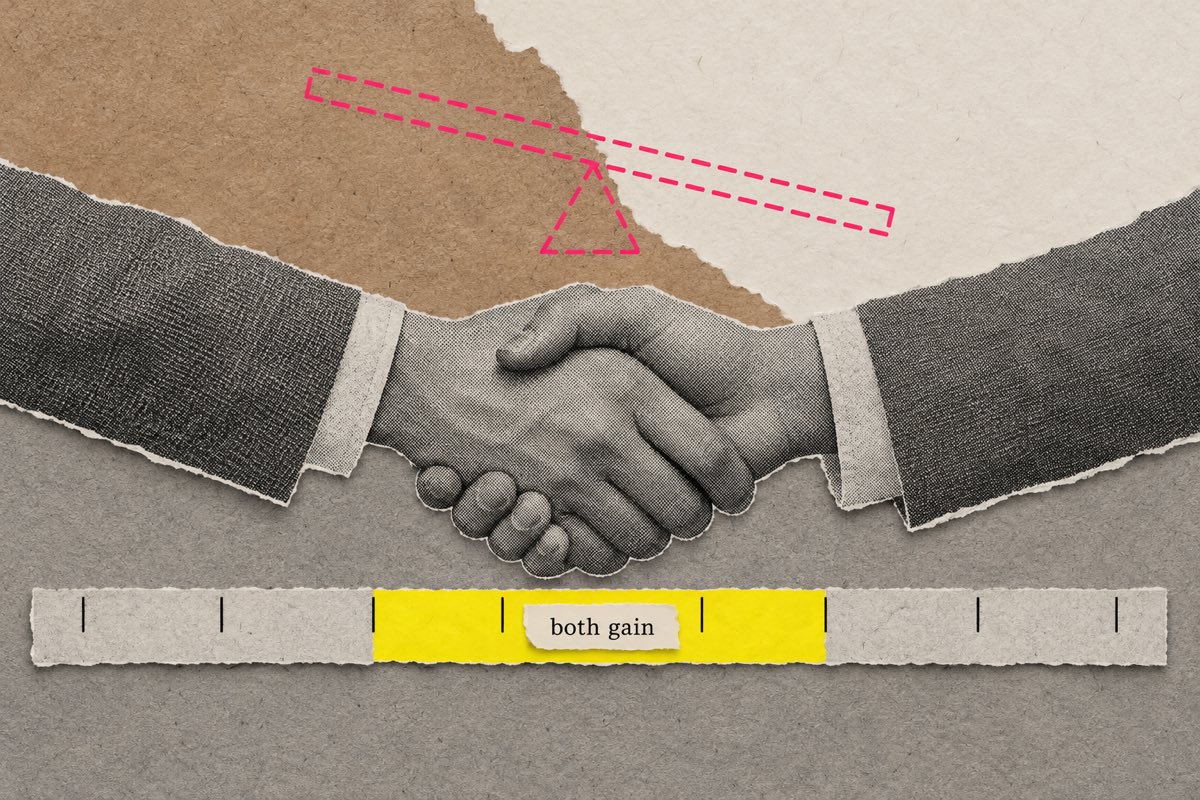
A lot of people dread negotiating, whether it’s a salary, a car or a contract, because it feels like a fight: whatever you win, the other side loses. So they avoid it, accept the first offer, and feel vaguely cheated afterwards.
Usually it isn’t a fight. In most deals both sides come out better off than if there were no deal at all. The negotiation is about how that gain is split, and once you see a deal that way, it becomes much less frightening and much easier to do well. Set the prices in the toy at the top and you’ll see the shape of it.
Try it
Who wins a trade?
A bike changes hands. The seller won’t take less than their price; the buyer won’t pay more than theirs. Set the price.
At $35, the seller gains $15 (over what the bike was worth to them) and the buyer gains $25. Both come out ahead: $40 of value created, whatever the price. The price only decides how it’s split.
Why a deal happens at all
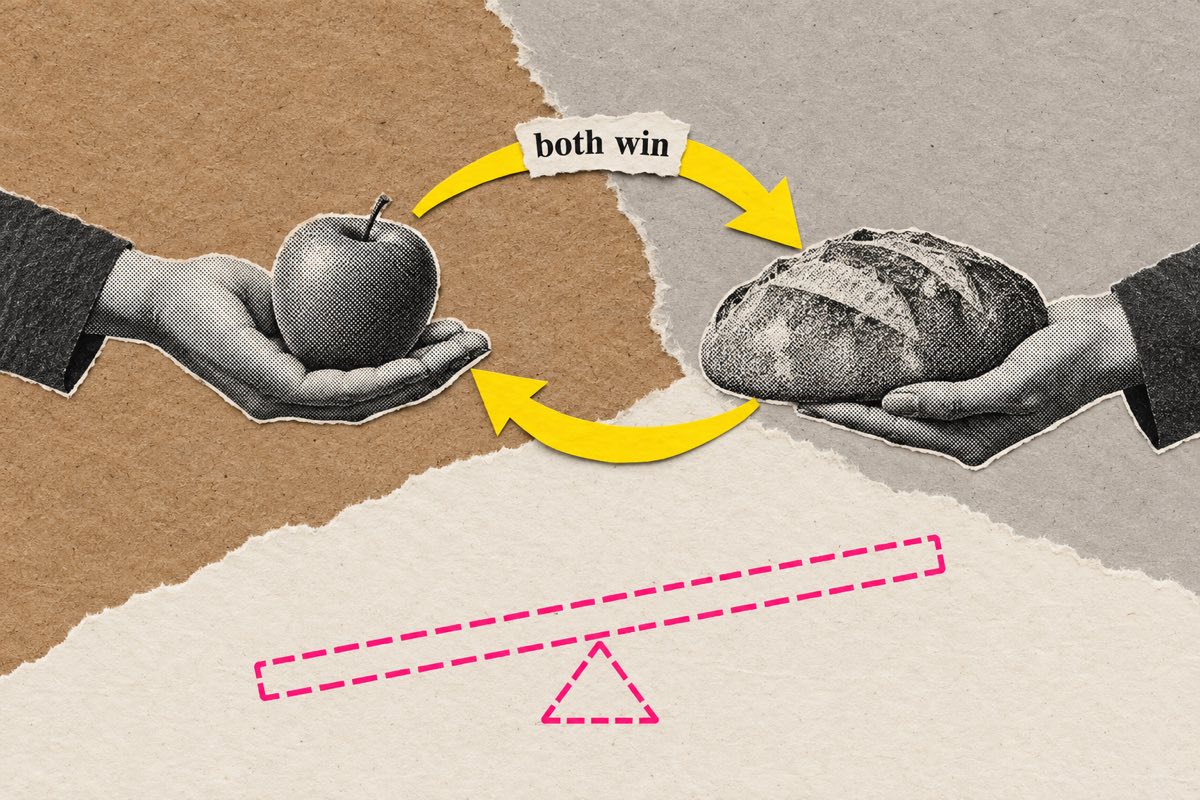
A deal happens when something is worth more to one side than to the other. A bike is worth $20 to a seller who never rides it and $60 to a buyer who needs one. At any price between $20 and $60, both are better off: the seller gets more than the bike is worth to them, and the buyer pays less than it’s worth to them.
That range is called the zone of possible agreement, a term popularised by the Harvard negotiation scholar Howard Raiffa. The bigger it is, the more value a deal creates. The price only decides where in the zone you land, and so how the value is shared.
Try it
Find the zone
A used bike. The seller won’t go below their lowest price; the buyer won’t go above their highest. Set both limits and a price, and see who gains what.
At this price the seller gains $30 and the buyer gains $30, compared with no deal. The deal creates $60 of value in total; the price only decides how it’s split.
This is the same idea economists mean when they say voluntary trade benefits both sides. Neither the buyer nor the seller would agree if it left them worse off. Bargaining over price can be tough, but the deal itself is a creation of value, not a transfer of it.
Your limit, and theirs
Each side has a point beyond which they’d rather walk away: the seller’s lowest price, the buyer’s highest. Negotiators call these the reservation points. If the buyer’s highest is below the seller’s lowest, there’s no deal to be had, and walking away is the right answer, not a failure.
Most people go into a negotiation with only a vague sense of their own limit and none of the other side’s. That’s the first thing to fix. Before you start, decide your walk-away point, in a number, and stick to it.
Where does your limit come from? From what you could do instead.
Your best alternative
In their 1981 book Getting to Yes, Roger Fisher and William Ury called this your BATNA: your best alternative to a negotiated agreement. If you’re negotiating a salary, it’s the other offer you have, or the job you’d keep. If you’re selling a car, it’s the next best buyer, or keeping the car.
Your BATNA sets your limit. It also sets your power: the better your alternative, the more willing you are to walk away, and the more of the gain you can ask for. Improving your alternative before you negotiate, by getting a second offer or a second quote, is often worth more than any tactic at the table.
It also works in reverse. Thinking about the other side’s BATNA tells you how far they can go. An employer who has been trying to fill a role for six months has a weak alternative; one with five strong candidates has a strong one.
What decides who gets more
Within the zone, the split depends on several things.
Who knows the other’s limit. If the seller knows the buyer would pay $60, they won’t take $25. Information is power, which is why good negotiators ask a lot of questions and give away their own limit carefully.
The first number. The first offer often anchors the rest of the conversation. In studies by Adam Galinsky and Thomas Mussweiler, whoever made the first offer tended to end up closer to their goal. A well-researched opening figure can pull the result your way. There’s even evidence that precise first offers, such as $4,850 rather than $5,000, are more persuasive, because they suggest you’ve done the sums.
Patience and alternatives. The side that needs the deal less can afford to hold out, which is another way of saying that the better BATNA tends to win more of the gain.
Fairness. People will walk away from offers they see as insulting, even when accepting would leave them better off. In the economic experiment called the ultimatum game, many people reject a split they see as unfair. A lopsided opening can sour the whole conversation.
The first salary negotiation
The place most people leave money on the table is the first job offer.
Try it
The first salary offer
In a study of graduates from a master’s programme at Carnegie Mellon University, how did negotiating their first job offer affect what people were paid?
Pick one. You’ll see why straight after.
The reasons people don’t ask are understandable: fear of seeming greedy, of the offer being withdrawn, of starting off on the wrong foot. In practice, a polite, well-prepared counter-offer is normal, and many employers build room for it into their first figure. If you’re nervous, frame it around the facts: what the role pays elsewhere, what you bring, and the other offer you have.
Making the gain bigger
The best negotiators also look for ways to make the zone bigger, not just to win more of it. Negotiation teachers often tell the story of two sisters arguing over an orange. They split it in half. One squeezed her half for juice and threw away the peel; the other grated her peel for a cake and threw away the fruit. Had either asked why the other wanted it, both could have had all they needed.
Real deals are full of oranges. A job offer isn’t only a salary: start date, remote days, training, title and bonus can be worth more to you than they cost the employer. A supplier might take a lower price for a longer contract or faster payment. Trading things you value differently, sometimes called logrolling, lets both sides gain more than haggling over a single number ever could.
The habit that finds these trades is curiosity. Ask what matters most to the other side, and why. Say what matters most to you. Then look for the things that are cheap for one of you to give and valuable for the other to get.
That’s the real reason one side doesn’t have to lose: a deal is something you build, not just something you split.
The most common mistakes
- Negotiating against yourself. Lowering your ask before the other side has even replied, because the silence feels uncomfortable. Make an offer, then wait.
- Splitting the difference too early. Meeting in the middle feels fair, but it rewards whoever opened most extremely. Ask what each number is based on first.
- Focusing on one number. Haggling hard over price while ignoring terms, timing and extras that may matter more.
- Treating the other side as an enemy. You often need them again, whether as an employer, a supplier or a neighbour. Firm on the problem, kind to the person, as Fisher and Ury put it.
- Forgetting the deadline effect. Most concessions happen near a deadline. If you know theirs and they don’t know yours, you have an advantage.
A short checklist
- Know your walk-away point and your BATNA, in numbers, before you start.
- Estimate theirs. What will they do if there’s no deal?
- Research the range. What do similar deals look like?
- Make or anchor the first offer if you’ve done your homework.
- Ask why. Find out what matters to them beyond the headline number.
- Trade, don’t just concede. If you give something, ask for something in return.
- Be prepared to walk away. If there’s no zone, no deal is the right outcome.
This page is general information, not legal or financial advice.
The free economics test asks whether one side always loses a trade, alongside nineteen other questions about how money and markets work, and the conflict style test shows how you tend to handle the moments when interests collide.
Questions people ask
- Is negotiation a zero-sum game?
- Usually not. In most deals, what’s being exchanged is worth more to one side than the other, so a deal creates value that didn’t exist before. The bargaining over price splits that value, and that part can be zero-sum, but the deal as a whole leaves both sides better off than walking away.
- What is a BATNA?
- Your Best Alternative To a Negotiated Agreement: what you’ll do if this deal falls through, such as another job offer or another buyer. Roger Fisher and William Ury coined the term in Getting to Yes. A stronger BATNA lets you hold out for more and walk away from a bad deal.
- What is the zone of possible agreement?
- The range between the most a buyer will pay and the least a seller will accept. Any price inside it leaves both better off than no deal. If the buyer’s maximum is below the seller’s minimum, there is no zone, and no deal makes sense.
- Should you make the first offer in a negotiation?
- Often yes, if you’ve done your research. First offers tend to anchor the conversation, and studies find that whoever makes the first offer often ends up closer to their target. If you know little about the other side’s limits, it can be wiser to let them go first.
- How do you negotiate a salary?
- Research the going rate, know your alternative, and give a specific, well-founded figure. Negotiate on more than pay: start date, flexible working, training, title and bonus can be worth more to you than they cost the employer. Be polite and clear; most employers expect it.
Sources and further reading
- Fisher, R., Ury, W. and Patton, B. (1981). Getting to Yes: Negotiating Agreement Without Giving In. Houghton Mifflin.
- Raiffa, H. (1982). The Art and Science of Negotiation. Harvard University Press.
- Galinsky, A. D. and Mussweiler, T. (2001). First offers as anchors: The role of perspective-taking and negotiator focus. Journal of Personality and Social Psychology, 81(4), 657–669.
- Babcock, L. and Laschever, S. (2003). Women Don’t Ask: Negotiation and the Gender Divide. Princeton University Press.
- Mason, M. F., Lee, A. J., Wiley, E. A. and Ames, D. R. (2013). Precise offers are potent anchors. Journal of Experimental Social Psychology, 49(4), 759–763.